
Frequently Asked Questions

1
How do I get started?
If you are considering therapy, you are welcome to get in touch by completing the contact form or contacting me directly.
We will begin with a free 10-minute enquiry call. This gives you an opportunity to briefly share what has brought you to therapy, ask any initial questions and get a sense of whether you would like to work together. If we decide to proceed, we can then arrange an initial assessment.
2
What happens in the first session?
Our first full session is an online assessment, held via Google Meet, and lasts 50 minutes.
This is an opportunity for us to explore what has brought you to therapy and why you are seeking support at this point in your life. We may talk about your current circumstances, important past experiences, relationships, your support network and what you would like to gain from therapy.
You do not need to prepare anything beforehand, and there is no expectation that you share everything straight away. The assessment also gives you an opportunity to ask questions and consider whether working together feels right for you.
3
How long is a therapy session?
Individual therapy sessions last 50 minutes.
4
Do you offer face-to-face or online therapy?
I offer both face-to-face and online therapy.
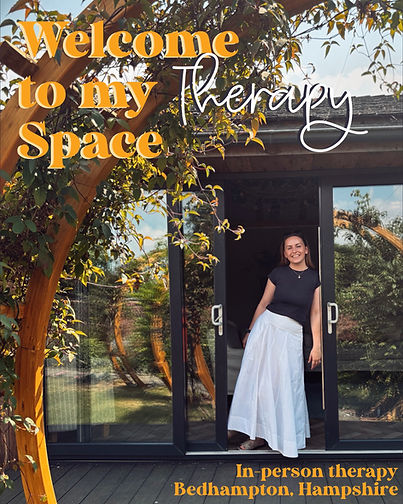
Initial assessments take place online via Google Meet. Following this, sessions can continue online or take place face-to-face at my private practice in Bedhampton, Havant.
Some clients choose one format consistently, while others may use a combination depending on their circumstances.
5
How much does therapy cost?
Individual therapy sessions are £50 per 50-minute session.
6
How often will I need to attend?
Therapy usually begins with weekly sessions. Meeting regularly can support the development of the therapeutic relationship and provide continuity for the therapeutic process.
As therapy progresses, we can review the frequency of sessions together. For some clients, moving to fortnightly or monthly sessions may feel appropriate at a later stage.
7
How many sessions will I need?
I offer open-ended therapy, which means there is no predetermined number of sessions you must attend.
Some people come to therapy to explore a particular difficulty, while others choose longer-term therapy to understand deeper patterns, relationships or experiences.
We will regularly review the work together so that we can think about how therapy is feeling, what is changing and whether it continues to meet your needs.
8
What can I talk about in therapy?
You can bring whatever feels important to you. You do not need to have a diagnosis, a particular difficulty or even know exactly what you want to talk about before starting therapy.
People come to therapy for many different reasons, including anxiety, grief and loss, relationship difficulties, pregnancy and baby loss, experiences of parenthood, identity, self-esteem, people-pleasing, difficult past experiences or simply a sense that something does not feel quite right.
Therapy can offer space to understand yourself and your experiences more deeply, at a pace that feels manageable.
9
What if I don't know what to say?
That is completely okay. You do not need to arrive at therapy knowing what you want to talk about each week.
Sometimes there may be something specific you want to explore; at other times we may begin with how you are feeling in that moment and see what emerges.
10
What type of therapy do you offer?
I work integratively, which means I draw upon different therapeutic approaches rather than using one fixed method with every person.
My work is relational, trauma-informed and attachment-informed, with an interest in understanding how our past experiences and relationships can shape the way we experience ourselves, others and the world around us.
Therapy is collaborative, and I adapt how I work depending on you, what you bring and what feels most helpful.
11
Is everything I say confidential?
Confidentiality is an important part of therapy. What you share within sessions is treated as confidential and your privacy is taken seriously.
There are, however, some limited circumstances where confidentiality may need to be broken, for example, where there are significant concerns about serious harm or where disclosure is required by law.
The boundaries and limits of confidentiality will be discussed during the assessment and are outlined within the therapy agreement.
12
Do you have client reviews or testimonials?
I do not publish client reviews or testimonials.
As a UKCP trainee psychotherapist, I work within professional ethical standards that place importance on client confidentiality, appropriate therapeutic boundaries and protecting the therapeutic relationship. For this reason, I do not ask current or former clients to publicly review or endorse my work.
13
Do I need a referral from my GP?
No. You can contact me directly and do not need a referral from your GP or another healthcare professional to begin private therapy.
14
What if I decide therapy isn't right for me?
Beginning therapy does not mean you are committing indefinitely. Therapy is collaborative, and we can talk openly about how you are finding the process.
If you decide you would like to end therapy, I would usually encourage us to have an ending session where possible. This gives us an opportunity to reflect on the work we have done together and bring the therapeutic relationship to a considered close.
